


Trimark Now Supports SEL RTAC and NovaTech Orion RIGs in CAISO Market
Feb 01, 2024
Trimark now supports third-party Remote Intelligent Gateways (RIGs) including the SEL RTAC and NovaTech Orion through the Trimark Operations Center….


Expert insight helps lower your risk and reduce costs -- a direct benefit to your bottom line.

Better for the Owner! Better for the Integrator! Better for the Grid!

End-to-end guidance from experts who have guided over 900 resources to successful grid connection.

The Trimark Operations Center (TOC) helps you maintain compliance and ensure accurate data.

A Comprehensive Training Ecosystem for Power Industry Professionals

Trimarkl's OCC delivers NERC-compliant monitoring, alarm response, dispatch, and failover capabilities.

We've got you covered with Services from concept to commissioning and Products from panel to the point of interconnect.
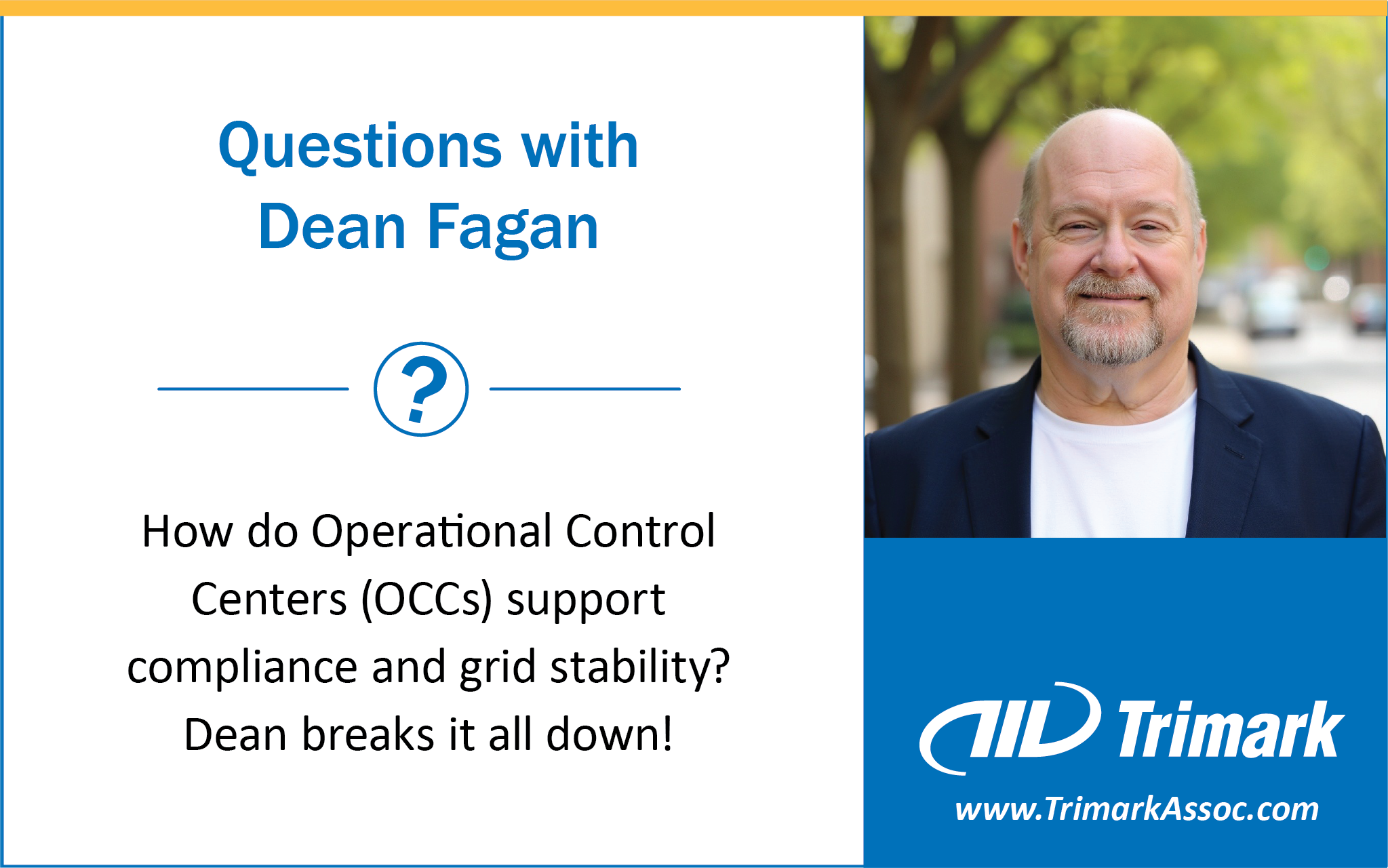
As Vice President of Real-Time Operations at Trimark, Dean Fagan has a big challenge – building a NERC-compliant, 24/7/365 Operations Control Center (OCC) to provide renewable resource management.
The good news is he’s done it all before. Three Times!
In fact, Dean has developed budgets, designed business practices, hired and trained staff, managed resource portfolios, reviewed performance data, directed technology architecture, and guided continuous improvement.
OCC entrepreneurship is a natural extension from mission-critical control system integration, regulatory compliance, and enterprise operations in critical sectors like electric power generation, oil and gas, technology manufacturing, and marine construction.
We spent a few minutes with Dean discussing this endeavor.
Scott McKinney: Let’s start with the basics; what is an OCC?
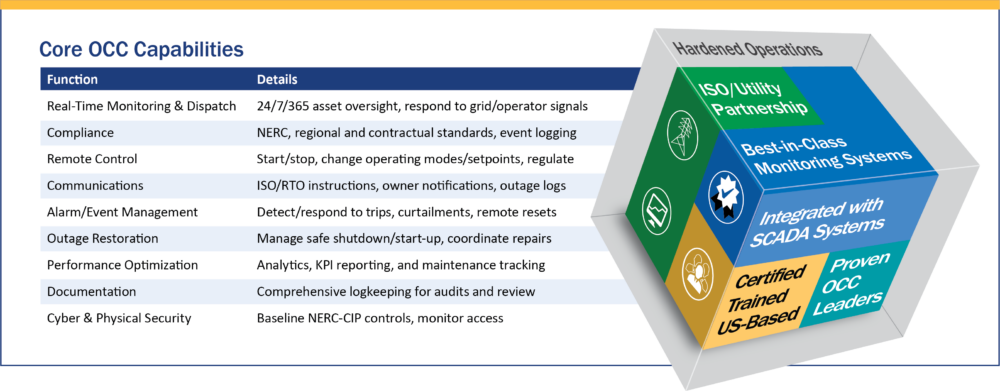
Dean Fagan: The Operational Control Center (OCC) exists for two fundamental reasons: protect the grid and safely operate generation resources for the owner. An OCC is a secure facility staffed 24/7/365 by trained operators who monitor and directly control electric power resources. Think of it as a centralized team dedicated to managing resources around the clock. That means the owner doesn’t have to put full-time staff at every facility. Trimark’s OCC will focus on utility-scale renewable energy resources – solar, battery storage, and related generation assets.
Scott: What does an OCC operator do during their shift?
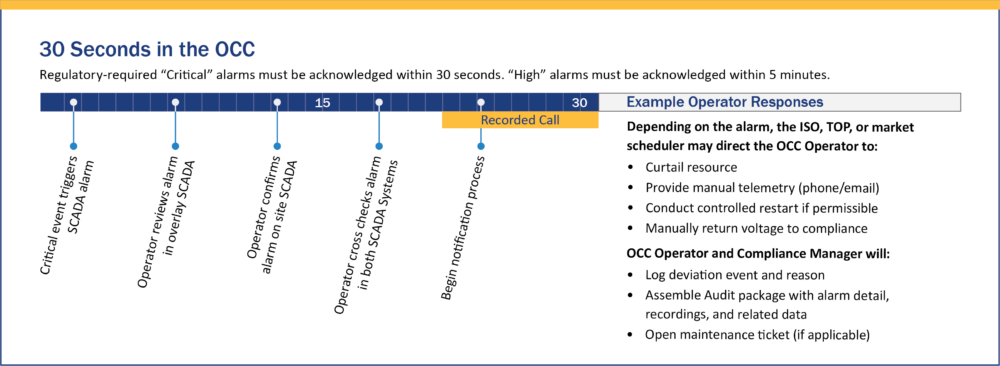
Dean: A typical shift starts by checking the health of every site under their care. Operators verify that systems are performing as expected. Then, when an alarm comes in, they assess the situation, determine what notifications are required, and take action based on strict standards, procedures and requirements. They may also execute directives from grid authorities, transmission operators, or market schedulers that may require operating a resource in manual mode. The operator’s job doesn’t end there. Every action and communication must be documented for self-reporting or audit review.
Scott: How does having a human in the process support grid stability?
Dean: Automation does a huge amount of work in stabilizing power delivery. However, some situations demand human experience and judgment, which is the fundamental purpose of the OCC. Here’s a common scenario. A grid authority may call the OCC to request a control action that supersedes control algorithms; VAR (Volt Amp Reactive) support on a grid segment for example. In that case, the operator would switch to manual mode to make the requested adjustment. That’s where trained operators play a critical role. In a large OCC, these refinements occur frequently which is why OCC operators maintain ongoing communication with grid authorities.
Scott: What does it take to become an OCC operator?
Dean: I’ve hired operators from a variety of technical and customer-facing backgrounds. One trait I look for is a desire to learn and build technical knowledge. Operators also need strong communication skills and a deep, practical understanding of electrical systems, controls, and industry terminology. They build expertise through structured training, operational experience ‘in the chair’, and certification programs.
Scott: What risks and compliance obligations do the OCC manage?
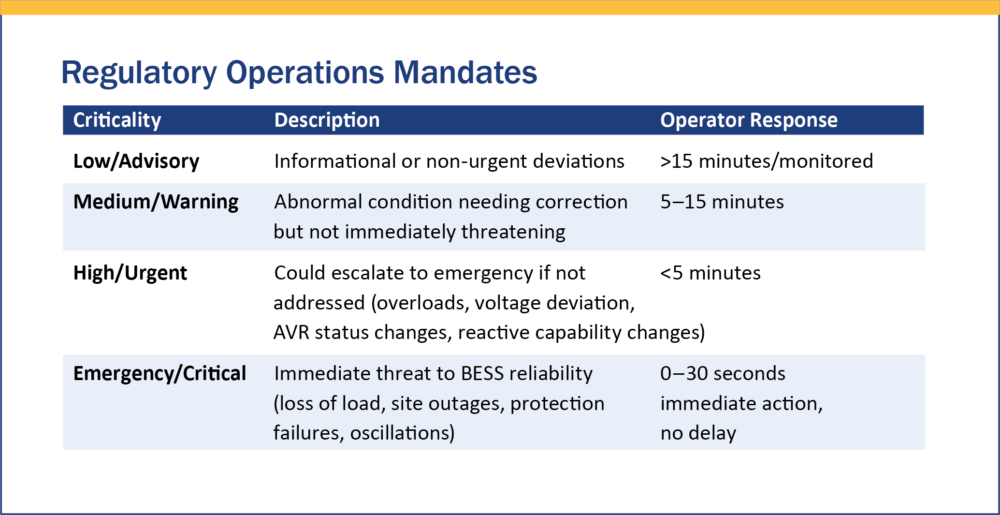
Dean: Different events and alarms carry different response requirements ranging from 30 seconds to 15 minutes or more, depending on their severity. Missing these response targets can create financial penalties, impact settlement, or incur fines. That requires understanding response obligations, regulatory requirements, contractual commitments, interconnection agreements, power purchase agreements, and regional expectations, then translating those requirements into operating procedures.
Scott: You’ve built OCC organizations before. What experience are you bringing to this effort?
Dean: I’ve built three OCC organizations from the ground up. That includes systems, staffing, processes, security, training, compliance and more. The largest OCC supported 145 utility-scale sites, more than 210 behind-the-meter sites, and had 26 operators. Throughout that experience we’ve learned a lot about what it takes to build, launch, operate, and scale an OCC.
“Resource owners are seeking a trusted partner to operate them. For Trimark, this is a natural extension of our existing client relationships and end-to-end services.”
Scott: Why is Trimark moving into this now?
Dean: The simplest answer is customer demand. As utility-scale renewables become a larger part of U.S. energy production, resource owners are seeking a trusted partner to operate them. For Trimark, this is a natural extension of our existing client relationships and end-to-end services.
Scott: How is the OCC different from Trimark’s TOC?
Dean: The OCC and the TOC are complementary. In practice, the OCC provides 24/7/365 monitoring, alarm response, call handling, and initial diagnostics. Issues that require deeper investigation are handed off to the Trimark Operations Center (TOC) for root-cause analysis and mitigation by technical experts. This allows the OCC to stay focused on their real-time obligations.
Scott: What is your role in Trimark’s OCC?
Dean: My role is to set the vision and make sure we have the resources, structure, and standards to operate the way we intend. That includes aligning the business with company goals, shaping the architecture, setting expectations for employees, and planning where the service can go next. New resources (such as battery energy storage systems) and new operating models (e.g. data centers) create new challenges and new opportunities for grid support. Part of my job is looking ahead and making sure we are continually improving.
Scott: One last question: outside of work, you have an interesting connection to conventions and Comic-Con. How did that start?
Dean: Over the years, I have represented several major gaming companies at conventions. I’ve even helped run and judge tournaments. That led to relationships with convention organizers and eventually to Comic-Con. In some cases, I’ve served as a personal assistant to a celebrity attending convention. I’ve worked around TV and movie personalities, authors, comic book artists, and writers. I’ve been doing it for more than 30 years, and it has been a fun way to meet people, build relationships, and stay connected to a very different kind of community.
Dean Fagan is Trimark’s Vice President of Real-Time Operations.
Scott McKinney is Trimark’s Director of Marketing
Trimark has successfully completed 2025 SQMD Plan Audits for its Scheduling Coordinator Metered Entity (SCME) clients in the CAISO and…
A Comprehensive Training Ecosystem for Power‑Industry Professionals Folsom, CA, June 2, 2026 — Trimark has announced Trimark Academy, a structured…
Folsom, CA, October 6, 2023 – Trimark has introduced cloud-based, Automatic Dispatch System (ADS) services to help small BESS and…
Project Type: PV generation rated at 28 MW plus 100 MWh/five hour energy storage facility Location: Between Lawai and Koloa…
Project Type: PV generating facilities and wind generating facilities – 21 sites Location: CA; one site in AZ Client/EPC: NRG…
Need a SCADA system that optimizes revenue? Need help meeting interconnection requirements? Want to stay in the market and avoid fines? Weʼve got you!